![[Work in progress] We run two main experimental labs: one focused on the biophysics of natural life, and the other on the robophysics of synthetic life. But beyond that, we are open to exploring any experiment (or theory) that sparks our curiosity!](https://images.squarespace-cdn.com/content/v1/61390fa275aafa5ee2157085/7647e925-6349-4d90-9fd0-8e9e161eaba6/Screenshot+2025-08-04+at+10.35.40%E2%80%AFAM.png)
[Work in progress] We run two main experimental labs: one focused on the biophysics of natural life, and the other on the robophysics of synthetic life. But beyond that, we are open to exploring any experiment (or theory) that sparks our curiosity!
ONGOING PROJECTS and CURRENT LAB MEMBERS:
Geometric-Agnostic Machine Learning
by Ava KazukoAn-Mei Tse, Angeline (Angee) Hu
Machine Learning Rogue Wave Solutions
by Kaitlyn Sumiko Yasumura, Kai Wong, Luciana Sarabia
Simulation of Statistics and Quantum Processes
by Siyue (Stella) Zhu, Julian Green, Penelope Messinger
Quantum-Cognitive Machine Learning
by Will Hammond, Luciana Sarabia, Caitlyn Mai
Designing Swarm Robot prototype
by Ava KazukoAn-Mei Tse, Stephany Maritza Rodriguez
FINISHED PROJECTS:
Digitization Can Stall Swarm Transport: Commensurability Locking in Quantized-Sensing Chains
with Caroline Nicole Cappetto, Penelope Messinger, Kaitlyn Sumiko Yasumura, Miro Rothman (2025)
Self-Image Multiplicity in Concave Cylindrical Mirror
with Kaitlyn Sumiko Yasumura (2025)
Size and Shape of Fuzzy Spheres from Matrix/Membrane Correspondence
with Olivia Mary Markowich, Angeline Hu (2025)
Generalizing the Shell Theorem to Constant Curvature Spaces in All Dimensions and Topologies
with Ava KazukoAn-Mei Tse, Olivia Mary Markowich (2025)
Adaptive High-Level Tight Control of Prostate Cancer: A Path from Terminal Disease to Chronic Condition
with Luciana Sarabia, Caroline Nicole Cappetto (2025)
LAB ALUMNI:
Olivia Mary Markowich (Fall 2025)
Miro Rothman (Fall 2025)
Caroline Nicole Cappetto (Fall 2025)
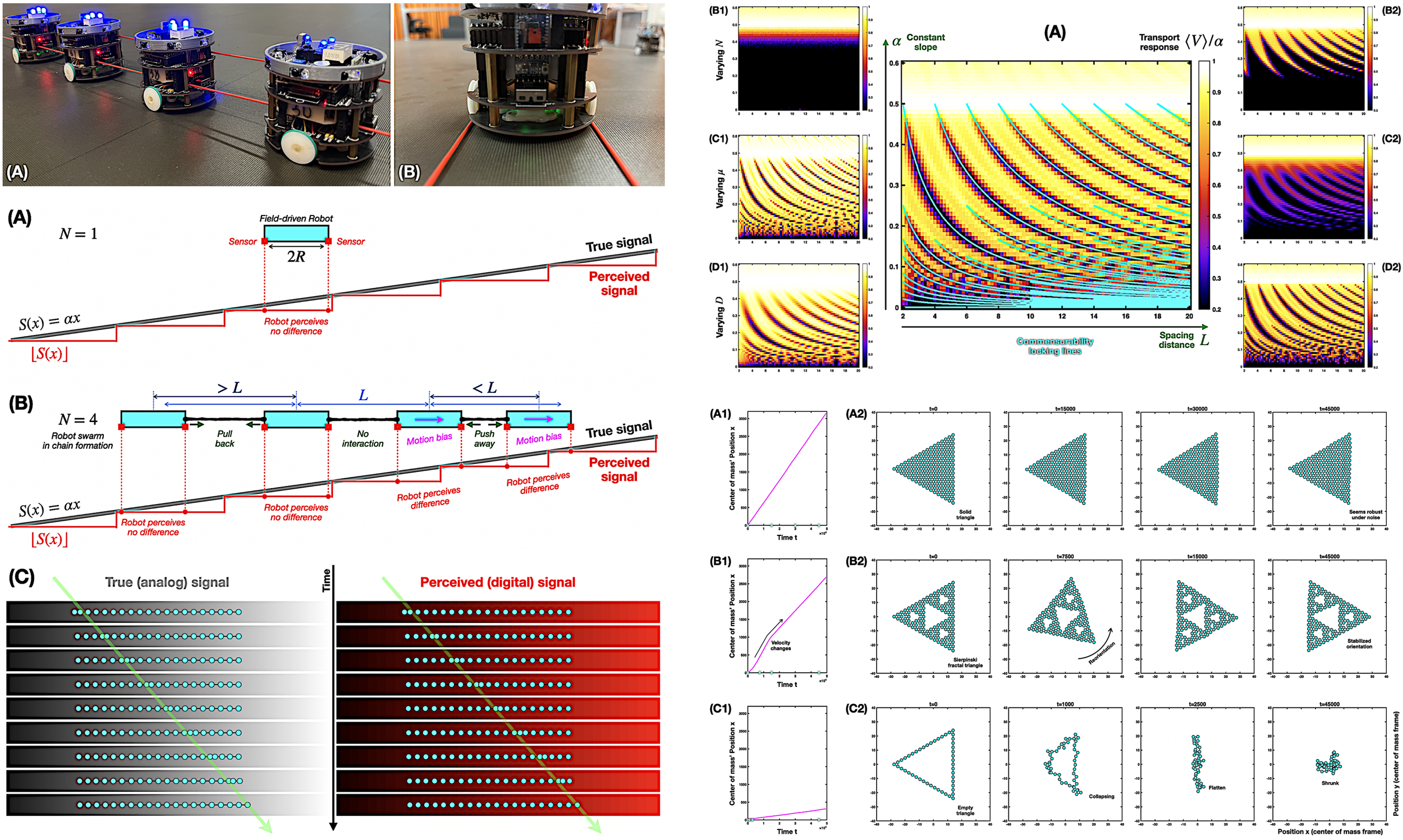
With Caroline Nicole Cappetto, Penelope Messinger, Kaitlyn Sumiko Yasumura, Miro Rothman, we investigate the collective transport properties of a robot swarms, in which each robot uses quantized-sensors to perceive the environment. We discover many interesting emergent phenomena that can be explained by number theory, and also found many more unexplained self-organized behavior.
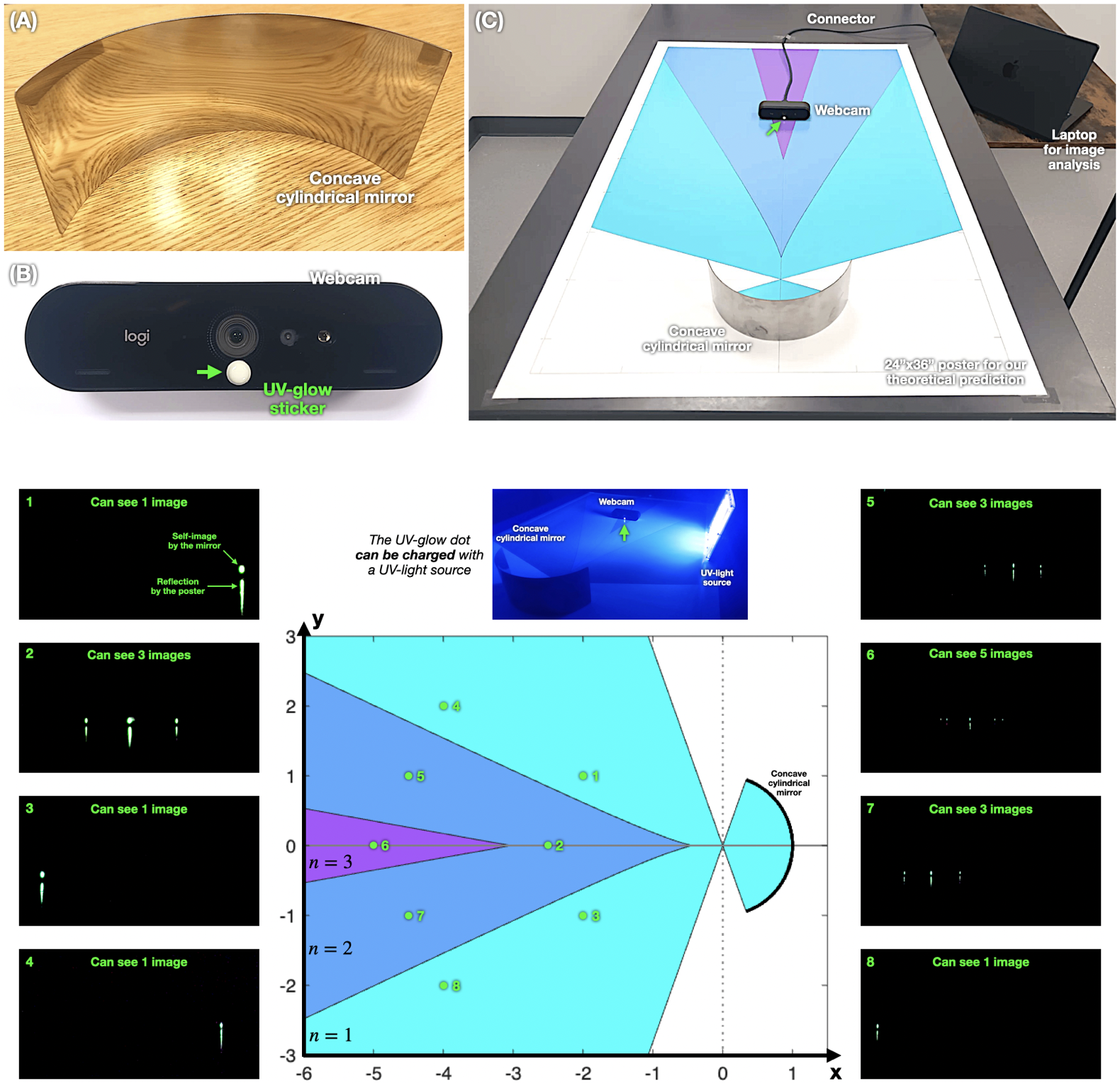
With Kaitlyn Sumiko Yasumura, we investigated the formation of self-images through a cylindrical concave mirror. We performed an imaging experiment to test our theoretical predictions for self-image multiplicity across different spatial regions.
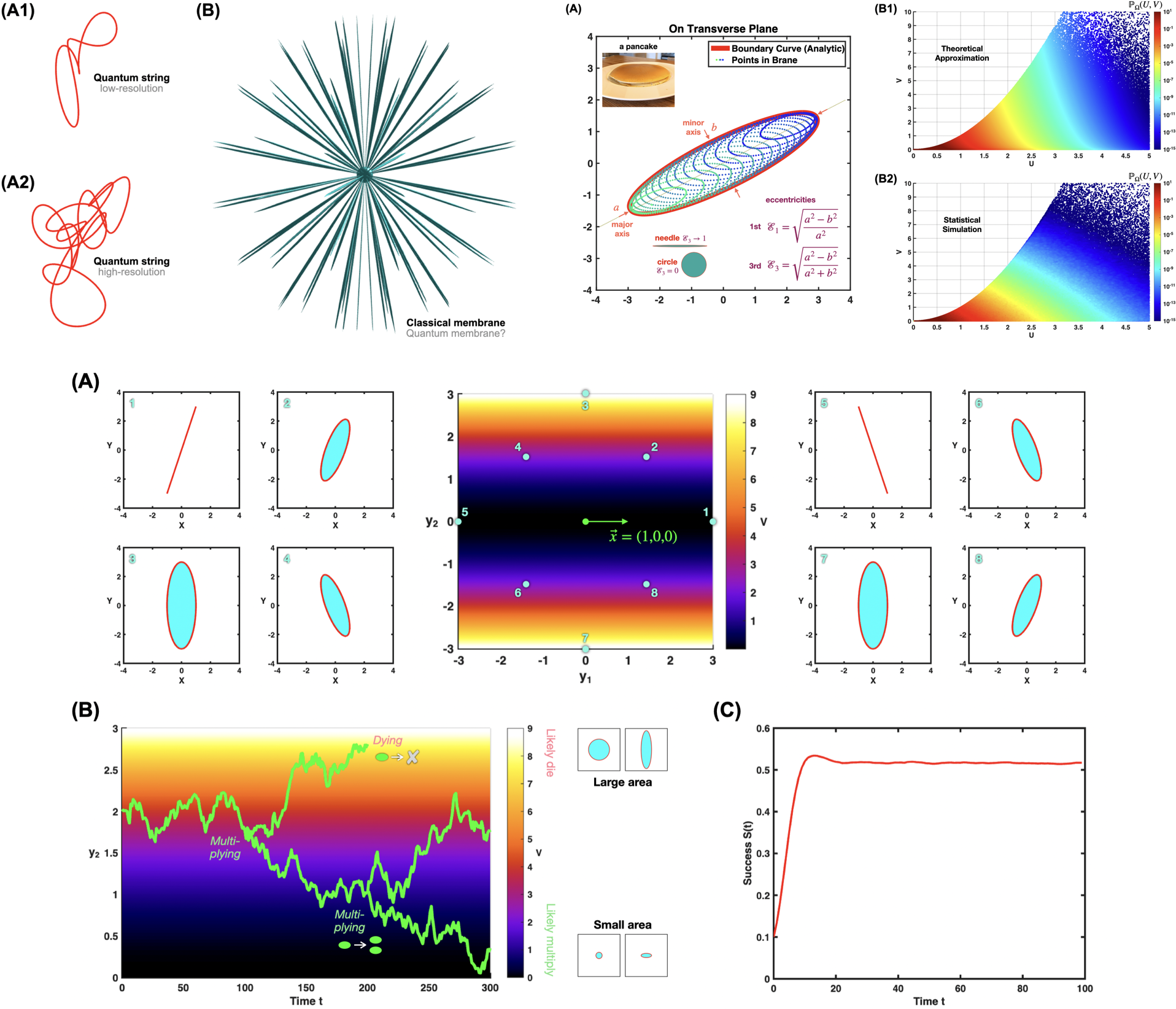
With Olivia M. Markowich and Angeline Hu, we studied the size and shape of ground state quantum fuzzy sphere in (1+3) dimensions, whose higher-dimensional and supersymmetric generalizations are fundamental objects in M-theory. Here, we simulated a population of random walkers on a fitness landscape, using their stationary distribution to infer geometric properties of the fuzzy sphere.
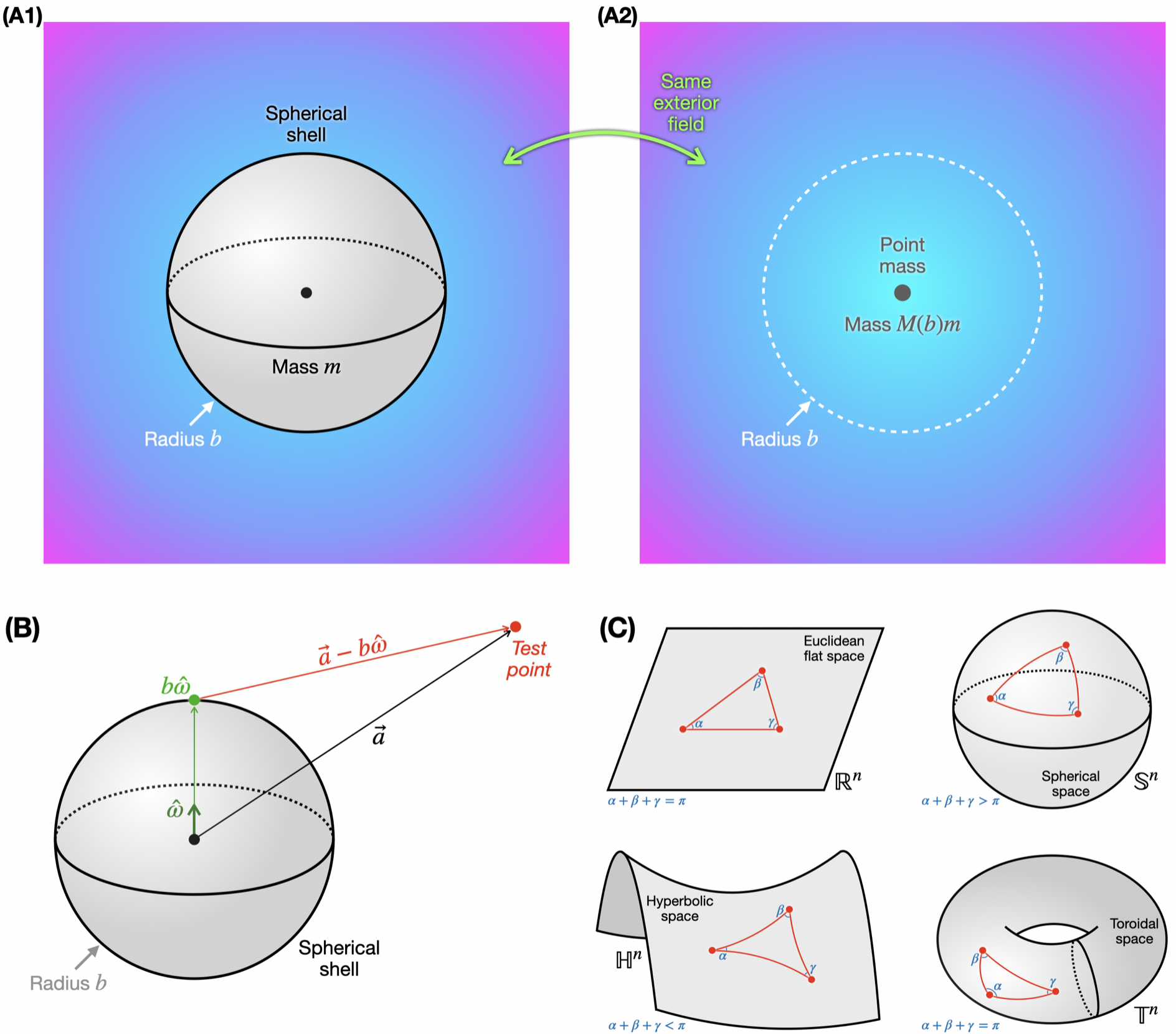
A gravitational interaction law has the spherical property when the field outside any uniform spherical shell is indistinguishable from that of a point mass at the center. With Ava K. Tse and Olivia M. Markowich, we proposed a method to identify all general potentials that possess this property on constant curvature spaces in any dimension and topology, using the Euler-Poisson-Darboux identity for spherical means.